Scite Review for Inspecting the Citation Context of a Known Paper – Toolveyor
Scite Review for Inspecting the Citation Context of a Known Paper
Scite review for checking one known paper: citation reports, statement labels, coverage limits, annual pricing and when a subscription is useful.
Written by Andrew White
•5 min read
You have a paper in your draft and a specific question: how have later authors used its findings? A citation total offers little help when the real issue is whether they discuss the same result, a limitation or an unrelated method.
Verdict:Scite is worth considering when citation-context reading is a recurring part of your work. Its reports can point you toward passages to investigate. The purchase makes less sense when your immediate problem is understanding one PDF or finding an initial set of papers.
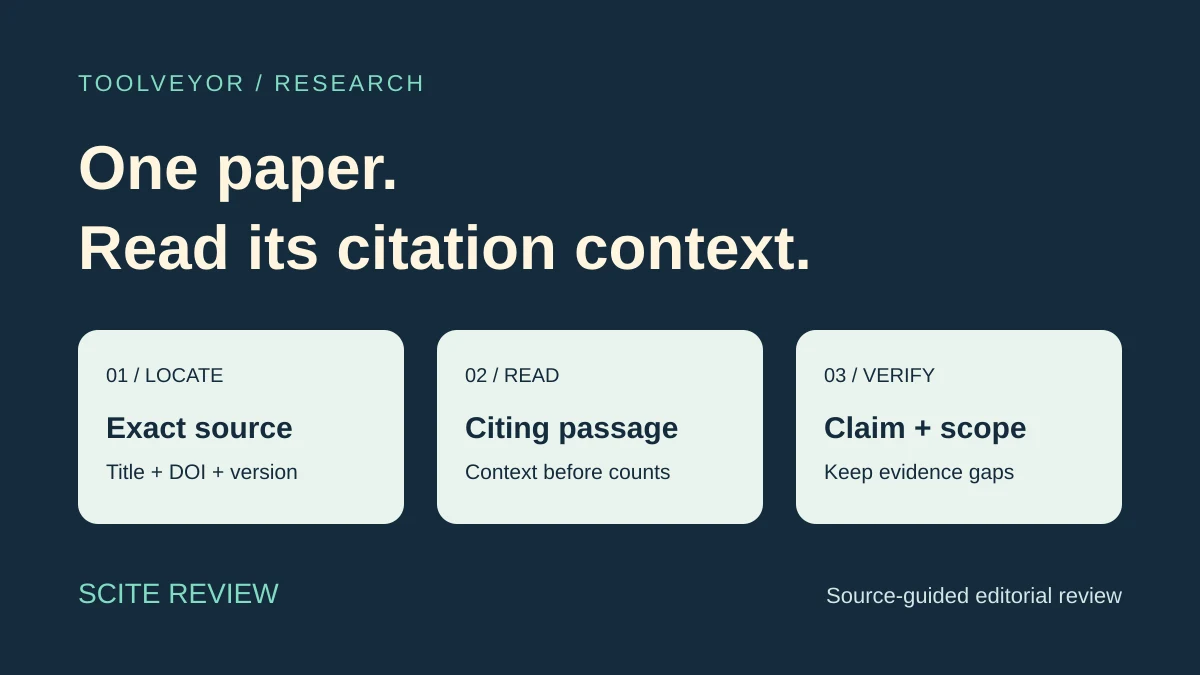
This is an editorial review of official product documentation and public access conditions checked November 7, 2026. We did not subscribe, run a paper audit or benchmark classification accuracy. The example report linked from Scite's features page returned HTTP 403 to our research browser, so we could not independently inspect that report's interactive controls. The cover is an original illustration.
Who should consider Scite?
A writer revisiting an important source, a researcher following a familiar paper or an editor investigating a contested reference has a clear reason to evaluate it. Each starts with a known publication and wants to read what came after it.
It is a weaker fit for someone expecting an automatic reliability score, a substitute for subject expertise or guaranteed access to every citing article. If you cannot read the underlying evidence, a more expensive subscription cannot resolve the interpretation for you.
Our research-claim checking shortlist compares the broader jobs of discovery, citation context and close reading. This review focuses on the decision after you already know which paper matters.
What its reports add to a citation count
Scite's features documentation describes reports that show citation passages and allow filtering by classification, section, year and source type. Its Smart Citations assign supporting, contrasting or mentioning labels to statements.
The useful distinction is between finding a passage worth reading and deciding what that passage establishes:
Share:
Report signal
Useful question to investigate
Conclusion to avoid
Supporting statement
Which result is being supported, and under what conditions?
The entire cited paper has been validated
Contrasting statement
Is the disagreement about my outcome, method or population?
Every claim in the cited paper is false
Mentioning statement
Is this background, a method reference or another use?
A neutral mention confirms the result
Many citation passages
Which independent studies address the exact question?
More statements mean stronger evidence
Scite's own thesis-writing guidance makes the statement-versus-paper distinction explicit. Our recommendation is to use the labels to organize reading, then make the judgment from the sources.
Collections and manuscript Reference Check are adjacent features. They may matter if the task grows into ongoing monitoring or reference-list screening, but they are separate reasons to buy; one known-paper check does not require adopting the whole platform.
A concrete evaluation before paying
Imagine a draft cites a study for the sentence “This training method improves retention for all employees.” This is a hypothetical editorial example, not a finding from a test.
Start with the exact publication. Scite's public search input accepts a title or DOI as well as other search terms. Confirm authors, year and publication version against the original record before interpreting a report. A similar title or an earlier version can send the review down the wrong path.
Then look for passages that address the retention outcome, including passages that could narrow the claim. If the available report provides the documented filters, use them to inspect relevant contexts rather than stopping at the first favorable label.
For each useful lead, open the citing source and record the passage location, study population, comparison and limitation. Ask whether it tests the same intervention and outcome. A later paper might support a narrow subgroup while leaving “all employees” unjustified.
A reviewable note could read: “Relevant citation passage found; full methods not yet accessed; population match unresolved.” That is a valid intermediate result. Do not replace it with a confident verdict because the interface displays a label.
The acceptance criterion for your evaluation is simple: can you follow the relevant statements back to evidence and produce a better-supported editorial decision? Possible decisions include retaining the sentence, narrowing its scope, removing it or leaving it unresolved.
Coverage and access are material limits
Scite's coverage page describes publisher indexing agreements and open-access sources. It distinguishes articles indexed from sources held in full text. A metadata record and a readable citation passage are therefore different kinds of coverage.
Treat missing context as a gap in the review, not evidence that nobody has challenged a finding. Cross-check important references through the original publisher and your usual literature search. Also distinguish what Scite can analyze from what you can personally access and inspect through your library or publisher account.
This limits the tool's value for papers whose relevant citing literature is difficult to retrieve. It also means a report should not be presented as an exhaustive systematic review.
Pricing: choose for the task, not the larger allowance
The public pricing page displayed these annual-billing offers at the time of review:
Plan
Displayed price
Relevant included access
Basic
$12/month, billed yearly
Assistant, Search, citation reports; Collections up to 1,000 papers
Pro
$40/month, billed yearly
Basic features plus API access; Collections up to 10,000 papers
Enterprise
Custom quote
Institutional access arrangements and larger allowances
Those are annual-billing rates, not verified month-to-month quotes. We did not complete checkout or verify taxes and the final invoice. Pro's team option adds seats; the displayed rate is not a flat price for an entire team.
The seven-day trial is temporary access, not an ongoing free plan. Scite says it converts to the selected subscription unless cancelled before it ends. Check existing institutional access first.
For this review's task, Basic already lists citation reports. Consider Pro only if a separate API or larger-collection requirement justifies it. More access does not make a classification more conclusive.
Strengths, drawbacks and suitable alternatives
The main strength is the connection between a known source and the language used by later authors. That gives a writer a concrete reading target. The documented filters could also help organize a large report, though we did not test their usability.
The drawbacks follow from the same design: a statement label compresses nuance, coverage can leave gaps, and the reader still needs source access and enough subject knowledge to interpret the passage. Scite helps locate the work; it does not eliminate it.
If your bottleneck is finding studies around a question, consider the discovery role of Consensus. If you already have a paper and need help understanding a section, consider the close-reading role of SciSpace. Our linked shortlist explains those alternatives and their access conditions as checked on its publication date; neither role is interchangeable with inspecting later citation context.
Next step
Open Scite's Toolveyor card, check your available access and choose one paper whose reception matters to a real draft. Before starting any trial, define what you need to resolve and how you will record unresolved evidence. Subscribe only if the available report supports a repeatable reading process that you actually need.