Elicit Review: Screening Papers for a Small Evidence Review – Toolveyor
Elicit Review: Screening Papers for a Small Evidence Review
Is Elicit worth paying for to screen research papers? Review criteria control, exclusion checks, Pro limits, current pricing, exports and suitable alternatives.
Written by Andrew White
•7 min read
Verdict:Elicit is worth evaluating when a small evidence review needs explicit screening criteria, documented exclusion reasons and a route from candidate papers to checked evidence. Its dedicated Systematic Review workflow is a paid feature. For a few papers that you already know you want to compare, the lighter Research Agent workflow or a manual decision sheet may be enough.
The purchase question is not whether Elicit can produce a plausible summary. It is whether you can understand, correct and preserve the decisions that determine which studies reach that summary.
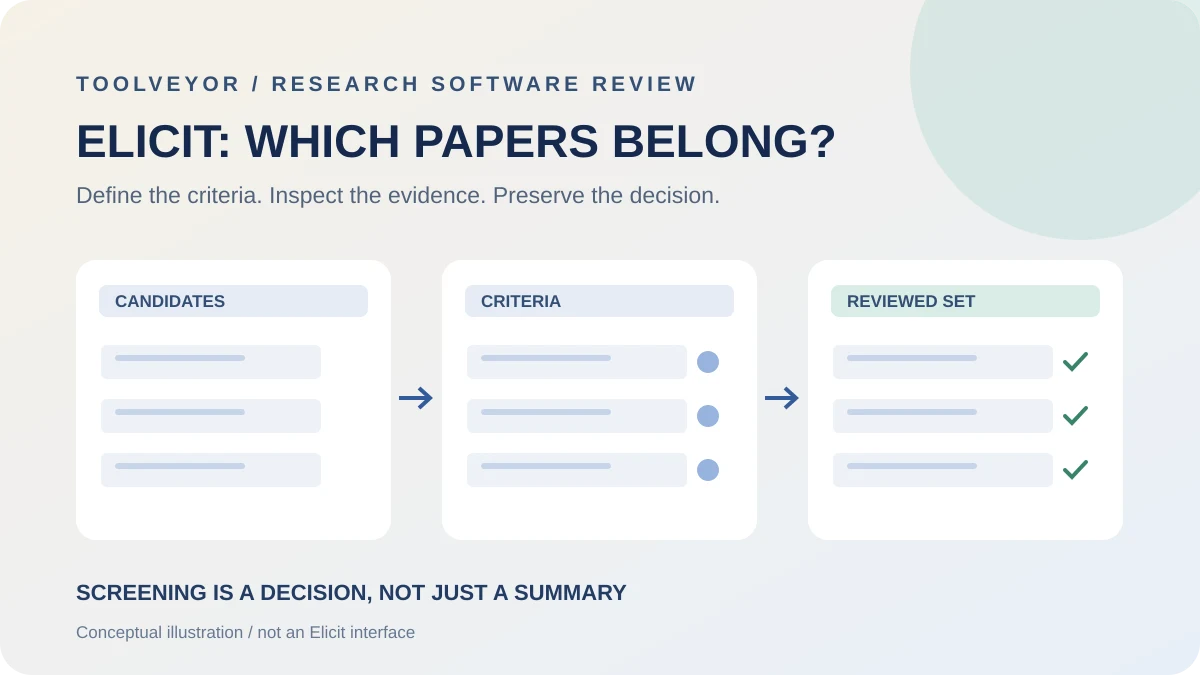
This review is based on official Elicit documentation and live pricing checked October 23, 2026. We did not run an authenticated screening exercise, measure recall or accuracy, or test exports. The pilot below is a proposed evaluation. The cover is a conceptual illustration.
Who should consider Elicit for screening?
Elicit fits an analyst who has a defined question and needs help organizing the selection process. The reviewer must still be able to read the underlying papers and resolve uncertain eligibility decisions. It is less suitable as an unattended gatekeeper, or as a purchase made before the team has agreed what belongs in the review.
Share:
Your task
Sensible starting point
What decides the purchase
Explore a topic and find candidate papers
Basic or a bounded Research Agent session
Whether discovery answers the initial question
Compare findings in papers already selected
Research Agent or a checked spreadsheet
Required fields, export and available usage
Keep explicit include/exclude decisions across a candidate set
Dedicated Systematic Review workflow
Criteria control, source evidence and recoverable decisions
Require independent reviewers inside the same screening system
Verify Enterprise requirements
The documented dual-review feature and its actual account availability
Our Elicit paper-comparison matrix guide covers the second row. This review concerns the earlier decision: which papers enter that matrix, and why others do not.
What the dedicated workflow gives you
The workflow selection guide separates Research Agent sessions, Research Reports and Systematic Reviews. The last is available on Pro, Scale and Enterprise and guides search, screening, extraction and a final report. A cited overview is therefore a different deliverable from a documented selection process.
Elicit's Systematic Review guide describes setup, paper gathering, title-and-abstract screening, optional full-text screening, extraction and reporting. Full-text screening requires the abstract-screening stage to be enabled. The sequence matters when choosing a workflow around eligibility details that do not appear in abstracts.
Its product overview describes suggested criteria, supporting quotations, per-criterion assessments and exclusion reasons. Those are useful controls because they give a reviewer something specific to challenge. They do not independently establish that the search was complete or the recommendation correct.
Criteria are the main buying decision
A hypothetical review might ask how remote-work arrangements are studied in employed adults. Before using any tool, decide whether student experiments, opinion articles and studies of unrelated workplace changes belong. State which outcome makes a study relevant. “Related to remote work” is too broad to reproduce consistently.
For each rule, separate what would justify exclusion from what would leave the record unresolved. A short abstract that omits an outcome is different from a full paper that explicitly measures something outside scope. Missing information should not quietly become a confident negative decision.
Pilot criterion
Evidence to inspect
A reason to pause
Population matches the question
Reported participants and employment setting
Abstract does not identify the population
Arrangement is actually relevant
Description of the work arrangement
A matching keyword refers to a different concept
Study reports the required outcome
Outcome definition and measurement
An interesting discussion replaces a measured result
Publication type is eligible
Study methods and publication type
Commentary is mistaken for an empirical study
This is an editorial example, not an Elicit template or a recommended universal research protocol. Adapt it to your actual review before asking an agent to suggest rules.
Check exclusions as carefully as inclusions
The help guide documents editing criteria and overriding individual Include or Exclude decisions, with exclusion reasons. A practical strength is that a reviewer can revise a decision rather than merely accept a generated narrative. The practical weakness is that poorly written rules can apply the same mistake across many records.
Inspect borderline exclusions during a pilot. Ask whether the supporting passage answers the criterion, whether it came from the available abstract or full text, and whether another version or report represents the same study. Preserve the rule version and the reason for a correction. Otherwise a later rerun can leave you with a changed paper set and no clear explanation.
Do not treat a relevance score as a study-quality assessment. Relevance to a question and methodological strength answer different questions; a highly relevant paper can still have limitations that matter to your conclusion.
Full text and a portable record are practical constraints
Access to a citation is not access to its full paper. Elicit's browser-extension guide describes retrieving full texts using existing institutional access, and reporting papers that need authentication or remain unavailable. It also supports manual uploads for the review workflow. We did not install or test the extension.
Check permitted full-text access before planning an eligibility rule that depends on methods or appendices. Keep unavailable records visible in your review log. Paying for research software does not establish access rights to every publisher's material.
The export guide says Pro, Scale and Enterprise can export Systematic Review screening-recommendation and extraction tables, including CSV and Excel options. Research Report PDF or Word export has different access rules. A free downloadable report does not prove that the screening table you need is included on Free.
Before committing, reopen a pilot export and check paper identifiers, decisions, reasons and the evidence references your handoff requires. Keep a dated decision log if the file does not preserve everything. We have not verified how a specific export retains quotations or revision history.
Prices and limits that change the decision
The live pricing page has separate Academic and Industry selectors. These USD figures are per user and were checked with both billing controls:
Plan and audience
Monthly billing
Annual commitment
Basic
Free
Free
Plus, Academic
$19 per user/month
$132 per user/year; $11 monthly equivalent
Pro, Academic
$69 per user/month
$468 per user/year; $39 monthly equivalent
Pro, Industry
$75 per user/month
$588 per user/year; $49 monthly equivalent
Annual equivalents require annual billing; they are not month-to-month prices or whole-team fees. Elicit's academic and nonprofit guidance explains the discounted audience and encourages nonprofits to use academic plans. Confirm the appropriate selector and checkout terms.
Basic offers limited agent and report use. Plus may meet a smaller extraction-and-export need, but the workflow guide places the dedicated review workflow on Pro and above. Do not assume that a plan card mentioning review-related usage includes the full screening interface.
The detailed review guide specifies up to 5,000 papers per Pro review, while the final Pro report can use up to 135 papers. A candidate-set cap is different from the output's source cap, and neither is a monthly promise of completed reviews. It also places dual review on Enterprise. General collaboration features are not evidence that a lower plan includes independent screening and conflict resolution.
Usage is shared, not a fixed review count
The usage guide describes a shared monthly pool across available workflows, replacing older fixed workflow counts. Screening depth, full-text work, PDF complexity and the number of criteria can affect consumption. Fast and Thorough are processing choices, not guarantees of a measured accuracy level.
Usage refreshes monthly, including for annual subscribers, and unused usage does not roll over. When the pool is exhausted, Find Papers remains available while other work waits for reset unless eligible extra usage is enabled. Pro and Scale can enable separately billed Extra usage with a monthly spending limit; the help page describes charges in $100 increments and settlement of smaller accrued amounts at cycle end. Keep that separate from the subscription price.
No fixed number of completed screenings within the monthly pool was confirmed. For a buying decision, observe consumption on a representative pilot rather than multiplying an older advertised extraction quota.
Strengths, drawbacks and alternatives
Elicit's strongest documented fit is an organized selection process with visible criteria and evidence, followed by structured extraction. Its main costs are the paid workflow threshold, variable usage and the human work needed to check exclusions. Source-linked decisions support review; they do not remove that work.
For a tiny candidate set, a manually maintained spreadsheet and reference list may be simpler to audit. That gives you direct control but leaves searching, deduplication and decision tracking to the team.
If your immediate task is discovery and a cited orientation to a question, Consensus is a task-specific alternative to inspect. Its official explanation describes searching scientific literature and grounding summaries in papers. This is not a claim that it provides Elicit's same screening workflow. Our Perplexity versus Consensus comparison addresses discovery choices rather than eligibility adjudication.
What to evaluate before paying
Use a small set of papers that a reviewer can assess independently, including clear matches, clear exclusions and ambiguous abstracts. This is a proposed pilot, not a test we ran. Write criteria before looking at the tool's recommendations, then compare each decision with the underlying evidence. Record disagreements rather than reducing the result to an attractive overall score.
Require three useful outputs: an understandable reason for each decision, a correction process that preserves your rationale, and a handoff another reviewer can follow. Check the current plan, remaining usage and export before increasing the paper set or accepting an annual commitment.
Next step: Open the Elicit card and decide whether you need discovery, a comparison matrix or the dedicated screening process. Choose Pro for a demonstrated screening requirement, not merely because the project contains academic papers.